
Pop Has Eaten Itself
or How I Learned to Love One-Sided Compromise

I thought I’d share a page from a book I recently bought online. It highlights some of the issues we’re currently facing in music, particularly in relation to its artistic expression and meaning. None of what follows is wrong—in fact, it’s all very sound advice—which is precisely what makes it so disheartening.
At some point (I can’t recall exactly when), the brilliant Ted Gioia (I highly recommend subscribing to his Substack, The Honest Broker) observed that one of the major problems with music today is that it has become the sole province of tech companies. Where there once was a chain of passionate individuals bringing music to stores, we now have impersonal “systems of delivery” in their place.
I’m not suggesting that the music industry was ever a paragon of artistic integrity or quality control—it was always a business—but at least it used to involve people who cared deeply about the art. Now, if you want your music to even be heard, there are specific targets you have to hit.
Take a look at this list of do’s and don’ts:
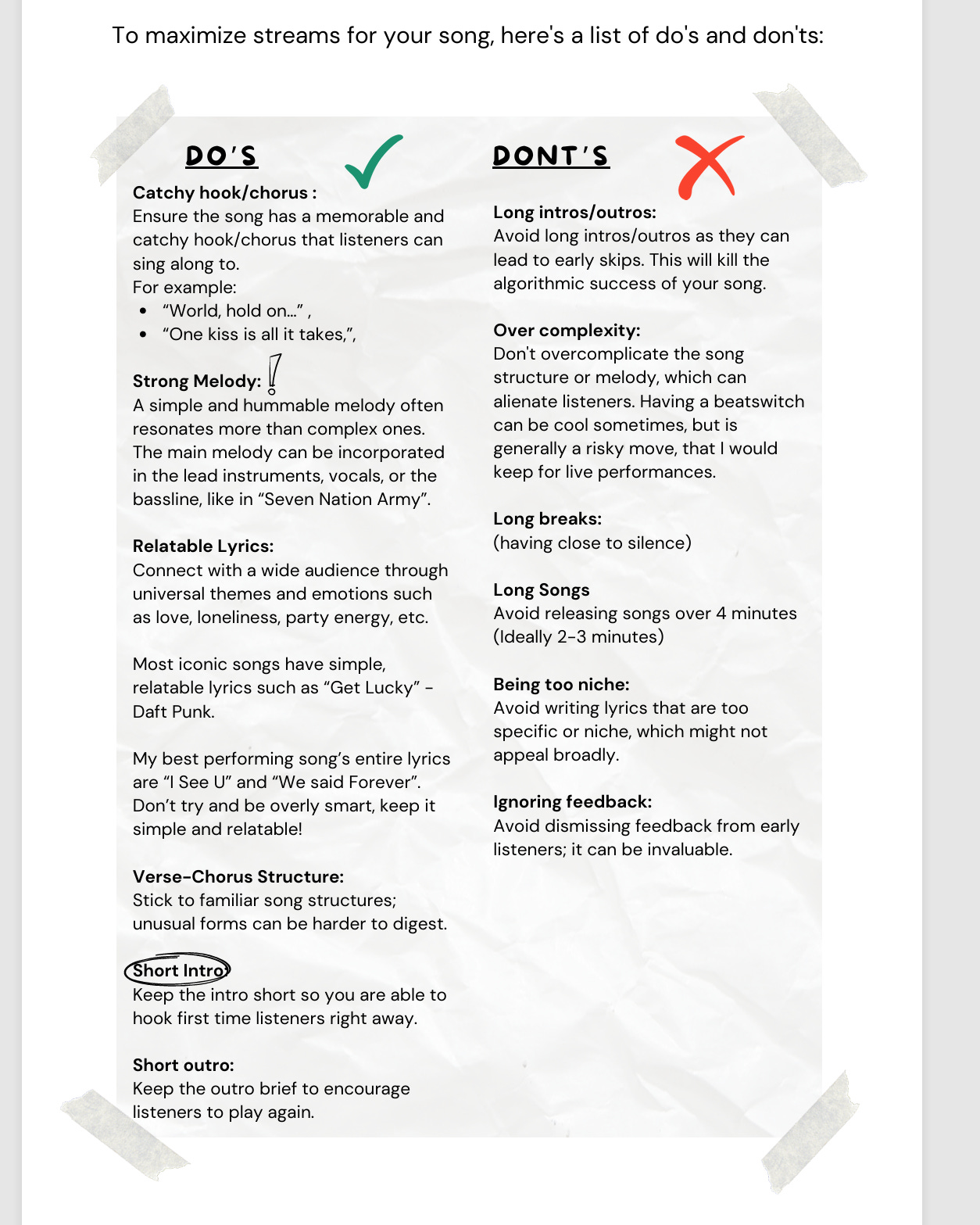
Some points, like “don’t ignore feedback,” are undeniably good advice. A strong melody, too, is universally valuable. But when it comes to decisions about complexity—both lyrical and musical—being told to avoid idealism and to stick rigidly to a format, you have to wonder: what’s the point?
This reads to me like a formula for disposable pop songs, which certainly have their place. But when artists are forced to make their intros shorter because of algorithmic constraints, who’s really winning? Not the listener.
Can you imagine trying to get a song like Wish You Were Here onto Spotify today? It would be skipped almost immediately, destined never to be heard again. Times change, of course, but I can’t help finding this state of affairs disheartening.
Of course, platforms like Bandcamp offer an alternative, but with Spotify looming over the landscape like some vast, uncaring colossus, it’s hard not to feel a bit pessimistic.
None of this would stop me—or many of my musician friends—from making music. It’s part of who we are; it’s in our DNA. But does that mean any of us will ever be able to make a living from it? With greater access to the technology that makes music widely available, coupled with the increasingly narrow parameters of what music "needs" to be, it seems that unless you're willing to completely abandon your creative vision, you're doomed to a handful of likes on SoundCloud and the occasional message from a bot.
As Jean-Michel Basquiat once said, “Art is how we decorate space; music is how we decorate time.”
Just make sure you don’t have an intro, and keep it under three minutes.